The Half-Life of a YouTuber
We analyzed ~100K YouTube channels. Median lifespan: 8.8 years. Annual mortality has nearly tripled since 2022. Six charts reveal what's actually driving it.

We analyzed 105,891 independent YouTube channels. One question: how long do they actually last?
The answer is more precise, and more alarming, than most creators or brands expect.
How long do YouTube channels actually last?
The age-at-death distribution has a clear peak. Of all the channels in our dataset that have gone inactive, the single most common age at last upload is 8 to 9 years. The median sits at 8.8 years, with the middle 50% of channels falling between roughly 6 and 12 years.
Age at going dark: % of 40,379 dormant channels
This is not a flat distribution. YouTube channels don't stop posting randomly across their lifespan. There's a distinct mortality cliff that builds from year 6 and peaks sharply at years 8 to 9. Channels that reach 12 or more years demonstrate exceptional resilience, and relatively few make it there. Only 3.8% of dormant channels went dark within their first 2 years; the majority post for years before eventually going quiet.
Monthly mortality rate: no plateau in sight
The percentage of alive channels going dark every month has risen without interruption from fractions of a percent in 2015 to over 2% per month by mid-2025.
Monthly mortality rate: % of alive channels going dark per month
The trend shows continuous acceleration with no plateau through late 2025. Two events mark visible inflection points on the chart: the mainstreaming of YouTube Shorts in mid-2021, and the beginning of the AI content wave in early 2023. Neither caused the acceleration on its own, but both appear to have steepened it.
Do newer cohorts burn out faster?
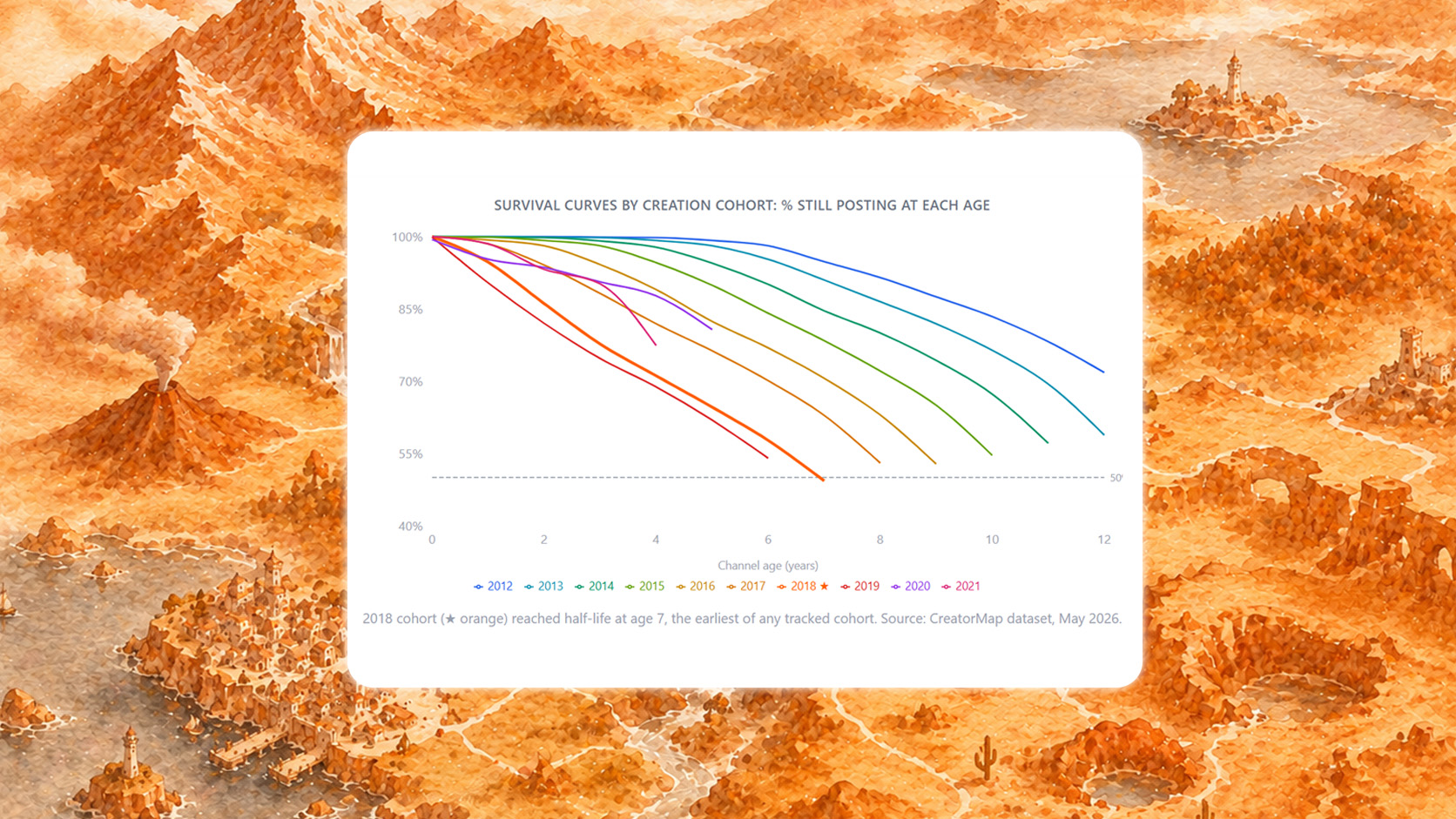
Tracking each creation year as its own cohort tells a nuanced story. The classes of 2012 through 2017 all show more than half their channels still posting as of mid-2026. YouTube creators are stickier than the discourse usually suggests.
Survival curves by creation cohort: % still posting at each age
The exception is the 2018 cohort, which reached its half-life at age 7, a full 1.8 years earlier than the overall median. Channels created in 2018 are dying at above-average rates relative to their age. The 2019, 2020, and 2021 cohorts show even steeper early attrition, though they are still young enough that drawing firm conclusions is premature. The trajectory is worth watching.
Your content genre is worth 4 years of lifespan
Genre turns out to be one of the strongest predictors of channel longevity in our data. Across 15 content categories, the spread between shortest and longest median lifespan is 4 full years.
Genre lifespan: years above or below the 8.8y overall median
Personal vlogging and general entertainment (the highest-volume, lowest-barrier categories) burn out fastest. Channels built around specific passions, skills, or communities outlast the average by years. Music channels last 10.4 years. Travel and activism channels push past 10.5 and 11.5 years respectively.
The data suggests specificity is a survival strategy. For brands: the genre of a creator's content is a meaningful signal for partnership longevity, not just current reach.
The 2023–2025 spike: aging demographics or platform shock?
The most common pushback on rising "going dark" numbers is demographic: a large cohort of channels was created in 2015–2017, so a pile-up of deaths around 2023–2026 is exactly what you'd expect from natural aging. This is partially true, and partially wrong.
% of creation cohort going dark each calendar year
The heatmap plots creation year against year-of-going-dark, normalized by cohort size. Before 2022, the pattern is mostly diagonal: channels dying at expected ages. From 2023 onwards, vertical bands appear. Channels created in 2010, 2015, and 2019 all show elevated death rates in the same calendar years. Age alone doesn't explain that. When channels of every age die at higher rates simultaneously, that is the fingerprint of a platform-level shift.
Annual mortality rate has nearly tripled since 2022
The clearest way to separate cohort aging from platform-level pressure is the annual mortality rate: deaths per 1,000 channels that were actually alive at the start of each year. This controls for both population growth and the 2015–2017 cohort bulge.
Annual mortality rate: deaths per 1,000 alive channels
| Year | Deaths per 1,000 alive |
|---|---|
| 2016 | 3.1 |
| 2019 | 41.7 |
| 2022 | 57.4 |
| 2023 | 76.5 |
| 2024 | 104.1 |
| 2025 | 161.6 |
The rate has nearly tripled since 2022 alone. Channels created in 2012 and channels created in 2019 are both dying at higher per-capita rates in 2024–2025 than in any prior year. When elevated risk appears across all ages simultaneously, that's platform pressure, not demographics.
What's driving the acceleration?
The data doesn't tell us directly. But the timeline aligns with several converging pressures:
- Short-form video mainstreaming: YouTube Shorts launched mid-2021 and permanently rewired what gets recommended and what audiences expect from the platform
- The AI content wave: starting late 2022, the cost of generating competing content dropped sharply, raising the relevance floor every independent channel must clear
- Sustained algorithm changes: repeated rewiring of the recommendation system has repeatedly disrupted channels that were previously stable
Any one of these could compress the viable window for independent creators. Together, they appear to be doing exactly that.
The 8.8-year lifespan isn't disappearing. But the probability of reaching it is declining at the fastest rate in YouTube's history.
Analysis based on 105,891 independent YouTube channels sourced from the CreatorMap dataset. Channels classified as active or low-engagement as of May 2026 are treated as right-censored observations in all survival calculations.