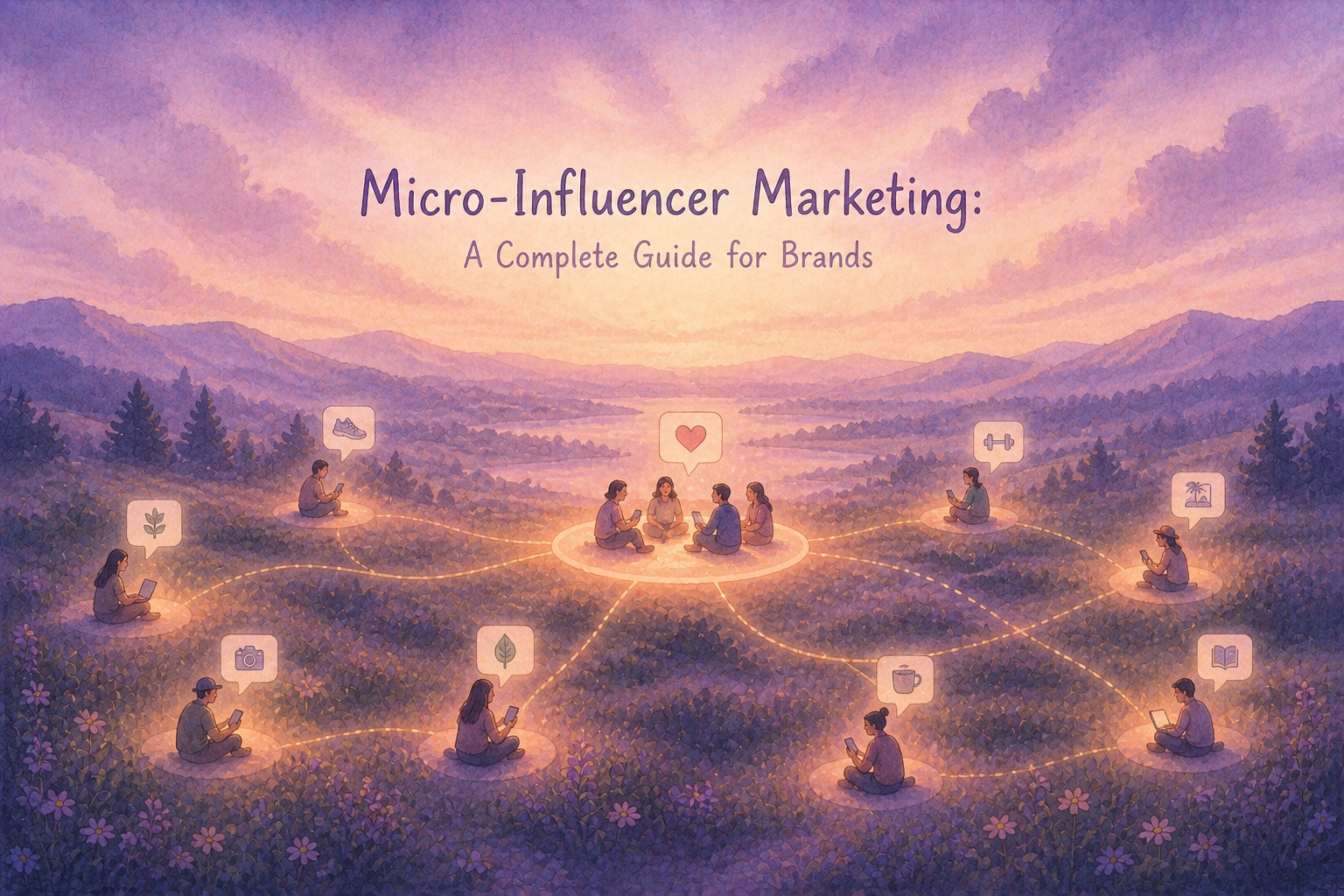
Micro-Influencer Marketing: A Complete Guide for Brands
Micro-influencers drive higher engagement and better ROI than mega creators. Learn how to find, evaluate, and run campaigns with the right micro-influencers.

Bigger is not always better in influencer marketing. Brands chasing massive follower counts are often leaving significant ROI on the table, while their competitors quietly build high-performing campaigns with smaller, more focused creators.
Micro-influencer marketing has become one of the most effective strategies available to brands of all sizes. This guide explains why, and how to do it well.
What Is a Micro-Influencer?
The influencer landscape is typically broken down by audience size:
- Nano influencers: 1,000 - 10,000 followers
- Micro influencers: 10,000 - 100,000 followers
- Macro influencers: 100,000 - 1 million followers
- Mega influencers: 1 million+ followers
Micro-influencers sit in a particularly valuable middle ground. They have enough reach to move the needle for most brands, but they retain the intimacy and trust that disappears as channels scale into the hundreds of thousands.
Their audiences tend to be tightly focused around a specific niche: fitness, personal finance, sustainable fashion, home cooking, and parenting. The people following them are genuinely interested in what they talk about, and that focus is the foundation of why micro-influencer campaigns convert.
Why Micro-Influencer Marketing Works
Higher Engagement Rates
This is the most cited advantage of micro-influencers, and the data consistently backs it up. As follower counts grow, engagement rates tend to fall. A creator with 15,000 highly engaged followers in a niche category will typically outperform a creator with 500,000 passive followers on metrics like likes, comments, saves, and click-throughs.
Engagement rates for micro-influencers commonly run two to three times higher than macro creators in the same category. That difference is not cosmetic. It translates directly into campaign performance.
Stronger Audience Trust
Micro-influencers typically know their audience. They respond to comments, run Q&As, and build genuine relationships over time. When they recommend a product, it feels like a trusted friend's opinion rather than a paid placement.
That trust is extraordinarily difficult to manufacture with a mega creator, where the relationship between creator and audience is inherently more distant. For brands where credibility matters most, such as health, finance, education, and sustainability, micro-influencers are often the only credible option.
Better Budget Efficiency
Working with a single macro influencer can consume a significant portion of a campaign budget with no guarantee of return. Micro-influencers charge considerably less per post, which means you can diversify across multiple creators, test different niches, and scale what works without betting everything on one placement.
For brands running multiple campaigns throughout the year, this flexibility compounds significantly.
Niche Targeting
If you sell a product with a specific target customer, whether that is a keto supplement, a project management tool for freelancers, or a baby carrier for outdoor parents, micro-influencers let you reach that audience precisely. There are creators who speak directly to almost every conceivable niche, with audiences who actively identify with that topic.
Broad reach is not always the goal. Reaching the right people is.
Micro-Influencers vs Macro Influencers: Which Is Right for You?
The honest answer is that it depends on what you are trying to achieve.
Choose micro-influencers when:
- Your product serves a specific niche or use case
- You want to test messaging across multiple audience segments
- Budget is limited and you need strong ROI
- Authenticity and trust are central to your brand
- You are driving direct conversions, not just awareness
Choose macro influencers when:
- You need rapid, broad brand awareness at scale
- You have budget to absorb higher risk per placement
- Your product has mass-market appeal
- You are building a cultural moment rather than a conversion campaign
Many brands find the most effective approach combines both: micro-influencers for conversion-focused campaigns and direct response, macro creators for awareness and brand-building moments.
How to Find Micro-Influencers
Finding quality micro-influencers at scale is the hardest part of this strategy. Here are the main approaches.
Search Niche Hashtags and Communities
On Instagram and TikTok, search hashtags that your target audience uses. Creators who appear consistently in those results with strong engagement are worth investigating. This is time-intensive but free.
Platform-Specific Search
YouTube is particularly valuable for finding micro-influencers in educational and review niches. Search for topics your customers would search for, and look for creators producing consistent content in that space with 10,000 to 100,000 subscribers.
Use an Influencer Discovery Platform
Manual search has a ceiling. Discovery platforms let you filter by follower count, niche, engagement rate, and audience demographics, surfacing creators who would take weeks to find manually.
More advanced platforms like CreatorMap go further, using semantic search to find creators based on content alignment and audience fit rather than just keywords. That distinction matters for micro-influencer discovery, where the best creators for your brand might never appear in a basic hashtag search.
How to Evaluate Micro-Influencers
Volume is not the goal. Quality is. Here is what to assess before reaching out.
Engagement Rate
Calculate engagement rate by dividing total interactions (likes, comments, shares) by total followers, then multiply by 100. For micro-influencers, look for rates above 3-5%. Anything below 1% in this tier warrants scrutiny.
Always check engagement across multiple recent posts, not just the best-performing one.
Audience Authenticity
Check for red flags: sudden follower spikes, generic comments that do not reference the content, very low comment volume relative to like counts. These can indicate purchased followers or engagement pods that inflate metrics without delivering real reach.
Content Quality and Consistency
A micro-influencer who posts sporadically or whose content quality varies wildly is a higher-risk partnership. Look for creators who publish regularly and maintain a consistent tone, style, and subject focus.
Audience Demographics
Does their audience match your customer? Ask creators directly for basic demographic data, or use a platform that surfaces this automatically. Reaching an engaged audience that cannot buy your product is a wasted spend.
Brand Safety
Review their recent content end to end. Check how they handle sponsorships. Search their name for any past controversies. Micro-influencers are often less scrutinized than larger creators, which makes this step more important, not less.
How to Run a Micro-Influencer Campaign
Start with a Clear Brief
Give creators the context they need without micromanaging the execution. Include:
- Campaign objective and key message
- Mandatory inclusions: product mention, CTA, discount code or affiliate link
- Brand tone guidelines and what to avoid
- Deliverable format and timeline
The best micro-influencer content happens when creators genuinely use and understand the product. Where possible, send the product ahead of time and let them form a real opinion before scripting anything.
Use Trackable Links and Codes
Every micro-influencer in your campaign should have a unique affiliate link or discount code. This lets you attribute performance accurately, compare creator results, and identify who to work with again.
Run Multiple Creators in Parallel
One of the biggest advantages of micro-influencer campaigns is the ability to test at scale. Run five to ten creators simultaneously, track results, and double down on the combinations of creator, messaging, and format that perform.
Over time, this builds a repeatable playbook for your brand.
Think Long-Term
The brands that get the most from micro-influencers tend to build ongoing relationships rather than one-off placements. A creator who genuinely becomes an advocate for your product will produce better content and convert more consistently than a creator executing a transactional single post.
Common Mistakes to Avoid
Choosing creators based on follower count alone. A micro-influencer with 12,000 highly engaged followers in your exact niche is worth more than one with 95,000 passive followers in a loosely related category.
Skipping the vetting step. The smaller the creator, the less publicly available information there is. Do not skip content review and audience checks just because the partnership cost is lower.
Over-scripting the content. Micro-influencer audiences follow them for their voice and perspective. Brand-heavy scripts undermine the authenticity that makes micro-influencer content work in the first place.
Running too few creators to draw conclusions. One micro-influencer campaign is an experiment. Five to ten is a data set you can actually learn from.
How CreatorMap Helps You Scale Micro-Influencer Discovery
Finding one micro-influencer manually is manageable. Finding twenty that all meet your quality bar, across different niches and platforms, is a different challenge entirely.
CreatorMap is built to solve exactly this. Instead of filtering through static databases by follower count and hashtag, you describe what you are looking for in plain language. The platform surfaces creators based on content alignment, audience fit, and brand positioning, which is especially valuable in the micro-influencer tier where the best creators rarely rise to the top of keyword-based searches.
You can compare creators side by side, review their content history, and build a shortlist backed by data rather than gut feel, across as many niches and creators as your campaign requires.
Frequently Asked Questions
What counts as a micro-influencer?
Micro-influencers typically have between 10,000 and 100,000 followers. Some definitions vary, but this range represents creators who have meaningful reach while still maintaining the high engagement and niche trust that makes them effective.
Are micro-influencers worth it for small brands?
Yes. Micro-influencers are often the best starting point for smaller brands precisely because they are accessible, affordable, and highly targeted. You can test campaigns with limited budget and scale what works.
How much do micro-influencers charge?
Rates vary significantly by platform, niche, and engagement level. Many micro-influencers are open to product gifting or modest fees, particularly if the brand fits their content naturally. As engagement and follower counts grow toward the upper end of the tier, expect rates to increase accordingly.
How many micro-influencers should I work with per campaign?
For meaningful results and data, aim for at least five creators per campaign. This gives you enough variation to identify patterns and draw reliable conclusions about what is working.
How do I know if a micro-influencer's audience is real?
Look at engagement quality: substantive comments that reference the content specifically, consistent view or interaction counts across posts, and organic follower growth over time. Third-party tools can also flag suspicious engagement patterns automatically.
Final Thoughts
Micro-influencer marketing is not a budget compromise. For many brands, it is the highest-ROI channel available.
The combination of niche precision, genuine audience trust, and accessible pricing makes micro-influencers a natural fit for brands that want measurable performance rather than vanity metrics. The challenge is finding the right creators efficiently and at scale.
Information on this site is provided for general informational purposes only. See our disclaimer.